

Timeline
Key moments and milestones that shape the project throughout its journey of inquiry

3 December 2024, Brussels

The European Research Council announced the results of the 2024 Consolidator Grants, selecting OttomanCORE for funding.
1-5 July 2025, M. Athos

The Ottoman Zograf Workshop, held at the Holy Zograf Monastery on Mount Athos, focused on holistic digital approaches to the monastery’s archival collection, aligning with the project’s broader objective of examining monasteries as agents in the redistribution of wealth and power.
7-11 July 2025, Bucharest

16th International Congress of Ottoman Social and Economic History: Grigor Boykov presenting on Bulgaria's Ottoman-era Settlement and Population Geography; Chavdar Kirilov discussing archaeological and historical data about fortified settlements in the Eastern Balkans that remained in continuous use in the Ottoman period.
15-19 September 2025, Skopje

At the 13th International Congress of South-East European Studies, Grigor Boykov organized a panel and delivered a paper titled “Ottoman Provincial Nobility and the Itinerant Dervish Convents in the Eastern Balkans.”
1 October 2025, Vienna

The project officially commenced.
17 October 2025, Vienna

The Vienna Hub for Interdisciplinary Ottoman and Post-Ottoman Studies (ViHOPE) was established, with Grigor Boykov serving as one of its founding members and the OttomanCORE project forming an integral part of Vienna’s vibrant Ottomanist scholarly community.
13 November 2025, Sarajevo

Grigor Boykov delivered a public lecture at the University of Sarajevo, moderated by Emir O. Filipović
17-20 November 2025, Innsbruck

Mariya Kiprovska spoke about the "Steppe Dynamics along the Lower Danube Borderland in the Late Medieval and Early Modern Period" at the 2nd Annual Conference of the Cluster of Excellence "Eurasian Transformations".
20 January 2026, Vienna

In the framework of the Alevi History Lecture Series at the Department for Alevite Theology at the University of Vienna, Mariya Kiprovska explored the deep entanglements and long-standing networks between Balkan Muslim elite dynasties and non-conformist dervish orders.
20 February 2026, Vienna

From Mount Sinai and Mount Athos to the Pontifical Armenian College in Rome and the Melk Abbey; from Byzantine nunneries to the modern Romanian Church; from Arabic Christian manuscripts and palimpsests to Ottoman documents and Armeno-Turkish heritage preserved in Vienna: our workshop discussions spanned centuries, languages, and confessional worlds.
10 March 2026, Istanbul
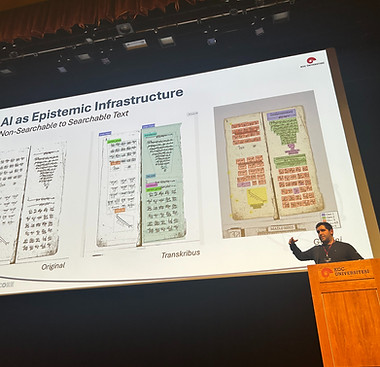
Efe Erünal spoke about the project's HTR program and actions at the Koç University AI Symposium 2026.
16-17 April 2026, Istanbul

M. Erdem Kabadayı, Grigor Boykov, and Efe Erünal joined the workshop The Tension between Data and Concepts in Ottoman Digital Humanities, organized by Orient-Institut and IFEA in Istanbul.
15-16 May 2026, Sofia

28-29 May 2026, Vienna
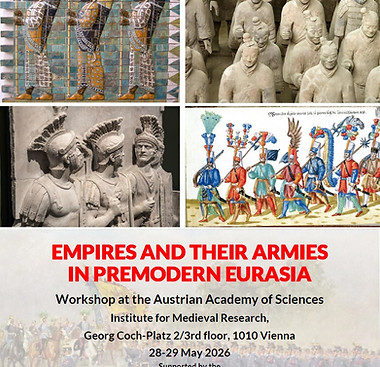
At the workshop Empires and Their Armies in Premodern Eurasia, Mariya Kiprovska presented her research on provincial aristocratic dynasties in the Balkans, arguing for a reassessment of conventional interpretations of the Ottoman military and socio-political order.
2-3 July 2026, Vienna

The OttomanCORE kick-off workshop was hosted by the Institute for East European History (IOG) in Vienna. The meeting brought together leading scholars in the field of Ottoman studies, both as speakers and as members of the audience, to discuss the key questions that need to be addressed when examining the emergence of Ottoman governance and the central role of the Balkans in this process. The workshop also engaged with a range of technical and methodological issues, including the potential of Ottoman HTR, AI-assisted data extraction, and the pressing need for an Ottoman prosopography.
5-10 July 2026, Leeds

OttomanCORE in Leeds. Emir O. Filipović presented on Religious Warfare and Crusading in the Early Modern Balkans at the Leeds International Medieval Congress 2026.
24-29 August 2026, Vienna

OttomanCORE was represented at the 25th International Congress of Byzantine Studies, held in Vienna from 24 to 29 August 2026. In a panel devoted to Ottoman-Byzantine confrontation in the fourteenth century, Mariya Kiprovska presented on the composite character of Ottoman military forces, highlighting the deep political, familial, and economic interdependence between Christian and Muslim actors among the Balkan nobility.
24-25 September 2026, Vienna

From Wallachian medieval charters, through European travelogues and historical maps, to Ottoman tahrir registers and archaeological remains, the discussions at our workshop approached mobility and transportation in the Balkans from a remarkably wide range of sources and perspectives. We discussed the reconstruction of historical routes; the multimodality of transport before and after the introduction of railways; the role of monasteries, dervish convents, and hans as hubs of mobility; and animal agency, not only as the driving force of transportation, but also as something itself transported. Insecurity, protection, and the very real concerns surrounding travel formed another important strand of the discussion. Perhaps the main takeaway from bringing together historians working with more traditional methodological approaches and scholars making intensive use of GIS and spatial analysis was just how much the field has advanced in recent decades and how much still remains to be explored. Important parts of the history of mobility in the Balkans remain effectively uncharted, offering considerable scope for new research, new questions, and closer collaboration across methodological boundaries.
2-4 October 2026, Budapest

Grigor Boykov and members of the OttomanCORE Sofia team, Chavdar Kirilov, Panayot Antonov, Mikaela Spasova, and Teodor Kostov, participated in the conference Before and After Mohács: Ottoman Archaeological Heritage in Europe, held at the Hungarian National Museum. At this first large-scale conference devoted specifically to Ottoman archaeology, Boykov and Kirilov presented their research on Konush, a key reference site for Ottoman archaeology, while the junior team members delivered papers on the use and spread of cowries and coins as adornments in the Ottoman Balkans and on the rich Ottoman-period collection of the Bulgarian National Museum.